How We Learn: Ear and Eye
/By Don Varyu
Apr 2026
Forms of media don’t just deliver information and learning. The way that’s delivered changes society—and us.
For 300,000 years, humanity used just two means of delivery: oral and written.
Now the digital age is ushering in a third era—and this change carries threats.

n the Beginning
The first primates who we would recognize as human arrived about 300,000 years ago. They formed into small groups of hunter/gatherers. Compared to their evolutionary predecessors, they excelled in both the formation of language, and also in task specialization. These advances would allow humanity to dominate all other life forms.
When those early tribes settled down for the night, there was nothing much to do but look up to the stars. This prompted the invention of mankind’s most powerful persuasive tool—the story. Maybe annoyed by restless kids, elders began to tell them stories about what they saw up in the sky. “Look over there—doesn’t that sort of look like a bear?” Or it could be a scorpion…or two warriors facing off. Those characters were embellished with traits and plot lines…and the kids eventually drifted off to sleep.
Those stories were told and retold until, thousands of years later, they morphed into the basis for much of Greek and Roman mythology. A good story has legs.
But the medium by which all these stories were communicated remained unchanged for millennia. Everything was told—spoken by the storyteller. And every storyteller changed the story a little bit. No one knew, or cared.
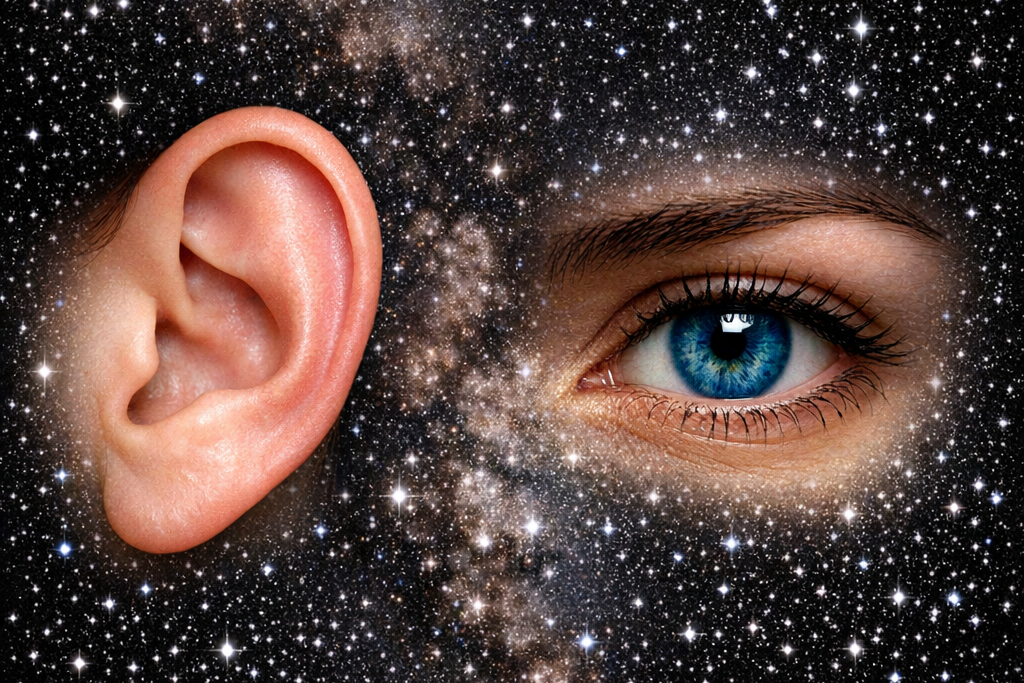
Theirs was a society of the ear.
t wasn’t until some 5,000 years ago that writing began. At first, it was just ledgers and lists recorded on clay scrolls or cave walls. To put this timing in perspective, if all of human existence were condensed into a single 365 day year, man has been writing for less than the last week.
Eventually, stories and contemplation were embedded within writing—and as they were, everything changed. This new medium of writing and literacy rewired not just how people communicated, but more importantly, how their brains worked. Cultural change followed in step.
Learning had moved into a realm of the eye.

et there Be Enlightenment
Reading information instead of listening to it let brains expand.
In 1985, Joshua Myrowitz wrote:
“The break from total reliance on oral communication allows people to become more introspective, rational, and individualistic. Abstract thought develops (away) from the circular world of sound, with its round huts and round villages. People move over time toward linear cause-and-effect, thinking (of) grid-like cities, (and) one thing at a time…and one thing after another.”
And with no need to gather around a campfire, “literacy allowed us to be alone while we learn.”
Linear groups of letters formed a word. A linear list of words formed a sentence. People were not just learning, but thinking in a different way.
Just as importantly, the invention of writing meant there was an actual record of what had come before…and what had been said. Gone was the need to rely only on memory. For the first time, you could look things up—even a century later. Which led to everything from property contracts to national constitutions to rules of the road.
Society transformed because the way people thought transformed.

ur Digital Age
If the hundreds of thousands of years of oral culture constituted phase one…and the dawning of literacy ushered in phase two…then where are we now?
Some social scientists say it’s a new age—a third monumental era of learning is underway. Our current digital culture may seem like simply a mash-up of both ear and eye learning. And in a sense, this is true. But beneath the surface, the scientists claim the nature of digital media is leaning us back into the ancient realm of orality. And that’s troubling.
The key is the development of what might be described as a constant feedback loop—people are forever “conversing,” even while sitting alone with a keyboard or a phone.
Here are two basic results:
The fluid flow. Researcher David Mir suggests digital platforms do not simply simulate speech; they restructure communication in ways that blend writing, speech, image, and performance into a continuous, interactive flow. Social media posts, online comments, and texts resemble dialogue more than formal writing. It is immediate, responsive, and shaped by audience feedback.
Another way of thinking about this difference is to imagine sitting and listening to a lecture…compared to overhearing an argument--and then deciding to jump into it. With digital, everyone is jumping in.
Distributed authority: Everybody has the chance to weighin. There’s no admission fee. In the words of podcaster Derek Thompson, this is, “…poor people yelling at the billionaires…the disenfranchised yelling at the people who disenfranchised them.”
At first, this seems beautifully “democratic.” But as we slip back to traits of oral communication, it can also sideline rational thought and reasoning. That’s because “distributed authority” can also work by attacking the validity of expertise. Many people claim their beliefs—their “gut instincts”-- are inherently superior to what “some expert” says. This is how established biological science can be overwhelmed by misinformed but passionate anti-vaxers.
Myrowitz concludes, “digital orality favors brevity, emotional cues, and rapid exchange. Argument often gives way to signal-affiliation, reaction, and stance.”
Another way to describe all this is group think.
rality opens the door to group think by empowering the “tribe.” This can upend most of the positive attributes that digital media can provide. This “new tribe” mentality means the following:
Conformity Pressure: consensus prevails over truth. If you don’t agree, you’re out of the group.
Acceptance of Authority: Often a single chosen voice, from behind a podium or pulpit, is accepted as delivering the infallible truth.
Echo Chambers: those who live in silos only hear what’s echoing inside them.
Tribalism: strong adherence to group norms can alienate those who are different, leading to social division and conflict. Or, more relevantly--hello polarization.
Author Walter Ong identified all this in a different way: “human beings in primarily oral cultures do not study.”
We all know that online “conversations” are often devoid of logic, reason, and reasonableness. They push us back to the world of the tribe. Podcaster Joe Wiesenthal describes the current environment of online debate as follows:
“…when you’re in an (online) conversation with someone...what are you doing? You’re often trying to impress someone. You might be trying to one-up someone. Maybe if there’s a few people there, you’re trying to put someone down, to look cool for the other person. You have to be funny, you have to be snappy.”
This is the way of the digital tribe.

he separation between literacy and orality is clearly reflected in our political system. Democrats are often accused of perpetually arguing with each other; they can “never agree on a message.” Democrats hold long but rational disagreements. The party practices distributed authority.
On the other hand, Republicans are criticized for always “being in lockstep”—apparently unwilling to say out loud what they really think. They slavishly accept the authority of Trump…and nestle together in their silo.
Both descriptions contain truth. But when you consider that about half of Americans say they don’t read or listen to even one book in an entire year, there’s not much doubt which party the non-literate favor.
The goal of the under-informed and misinformed is clear: Make America Tribe Again..

o, if the return to orality represents a threat…could there be a counterbalance? Any chance for a revival of literacy and rational thinking? Could ear and eye happily live together again?
Some point to an unexpected source: AI.
It’s true that AI may indeed come for your job. And you better fact check it before you trust it.
But it also holds the potential to help us learn more quickly and ponder more deeply. It offers voluminous content to consider and manipulate. It is already leading to faster cures for disease.
I asked Claude to provide a simple description of Einstein’s Theory of Relativity that a sixth grader could understand. That took just over three seconds. I asked for a photo-realistic image of Einstein riding a unicycle dressed in a tuxedo. That took a whopping 24 seconds.
What AI represents to us could indeed be the best of both worlds. It can “talk” to us like an old, oral storyteller…and at the same time supercharge both knowledge and imagination. It could be your wisest old friend…and your extra-energized brain.
No one can accurately predict the future of AI. But if it can just stop people from endlessly yelling and insulting each other online over the latest conspiracy theory, it would be huge a step forward.
Let the ear and eye live in peace.
