
How We Elect: Real and Cruel
/By Don Varyu
Apr 2026
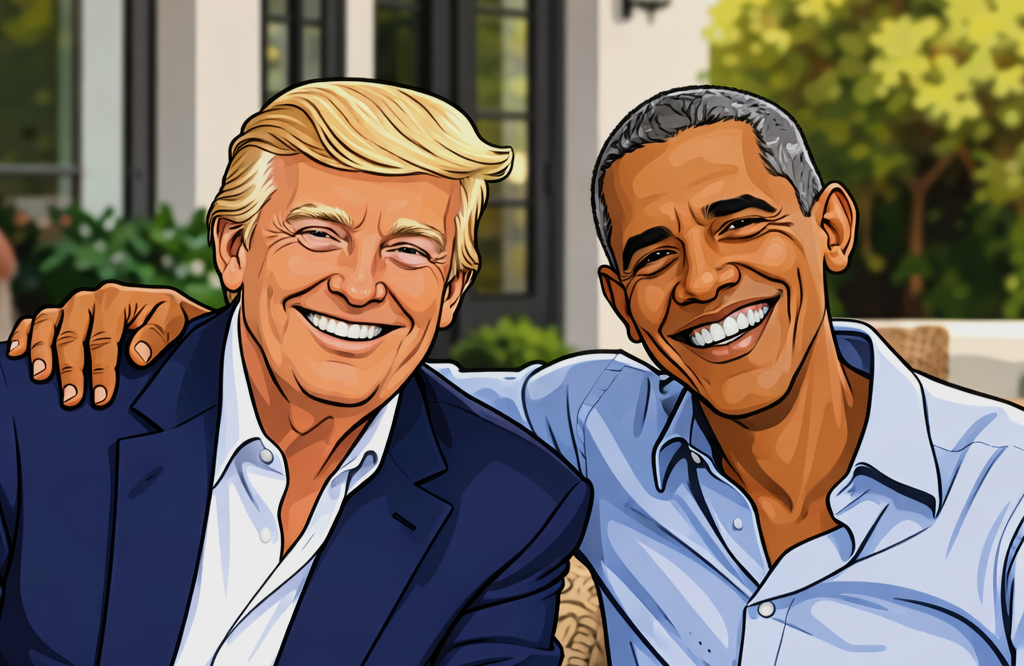
Americans choose their leaders with one characteristic in mind—well, maybe back of mind. It has nothing to do with policies, resumes, or campaign ads.
It’s about the singer, not the song.
Both parties would be wise to keep this one characteristic front and center in the run-up to 2028.

HE REAL
Barack Obama and Donald Trump do not like each other. They are not at all like each other. They are so dissimilar that loyal fans of either would never consider voting for the other.
And yet, the American electorate chose each of them—twice—to lead the country. What gives? They couldn’g be more different. The truth is that they mirror each other in one decisive way that deeply resonates with voters.
o explain, let me begin with a personal anecdote. Several decades ago I was asked to write a booklet that was sent as a “think piece” to every client of our global communications firm. It was called, “The Next Fifty Years.” It sounds pretentious—and it probably was. And I admit that, in hindsight, much of what it predicted today seems pretty obvious (e.g., multiculturalism, the rise of global brands, the impact of aging populations).
However, the conclusion of the booklet began with an entirely different thought:
“We’re at the dawn of an era where people want authentic stories about authentic people.”
Authenticity is the behind-the-scenes element that helps make presidents—as well as trusted leaders in any organization. But where does this come from? How do you develop it?
In 1959, author Irving Goffman coined the terms “front stage” and “back stage” to describe something we all recognize in ourselves. We act and talk differently depending on circumstance. For example, we will present ourselves differently when first meeting our spouse’s family…than we will talking about that encounter later with our best friend.
Without really thinking, we all do a version of “front stage” and “backstage.” It’s natural. But sometimes, people get the chance to see both sides. Maybe it’s the chance to view a “secret” moment. Or maybe watching someone who suddenly seems to react emotionally, rather than pre-scripted. When these things happen, the “curtain drops”. and the gap between “front stage” and “back stage” becomes clear. The observer feels he’s viewing the “real” person. The smaller the gap between “front stage” and “back’, the more we feel we know the “real” person. For better or worse, there is authenticity.
The truth is that both Trump and Obama gained popularity in no small part due to throt perceived consistency. As distinct as they are as personalities, people judged them to be pretty much the same people onstage and off.
Detractors may have viewed Obama as empathetic, but also diffident—too cerebral and a little too cool for school. But glimpsing him at campaign rally, even raising his voice in anger, he maintained the empathy and control. He seemed authentic.
Trump will always have foes because of his bombast, his brinksmanship and his b.s. But it hardly seems like an act. He complained about Joe Bioden even chatting with a group of young kids at the White House Easter Egg event. Sure, he lies, cheats, steals and whines—but we know he does that with everyone—all the time. He is consistent: his “front stage” and “backstage” are identical. We know what we’re dealing with. He, too, feels authentic.
Now, if you doubt the power of this, let me throw one more former presidential contender into the mix.
On the day of the 2016 election, exit pollsters asked Trump voters, “if not Trump, who would your second choice have been?” The clear winner was not another Republican—it was Bernie Sanders. He and Trump could not be further apart on economic policy or politics. But those Trump voters could imagine Sanders snarling into the mirror while brushing his teeth in the morning…just as he would do on a rally stage later the same afternoon. He may be a grouch; but he’s a consistent one. That was always him—authentic.
Scholar Simon Sinek concludes, “Authenticity is not about being perfect. It is about being real.”
People have a nose for “real.” People can tell.

RUEL
So, this may seem simple, but there’s an obvious downside:“real” can have a nasty edge. A “real” person can also be really cruel.
There’s a long line of words that describe these kinds of humans: “bully,” “blowhard,” “show off,” “braggart,” “pompous,” “know-it-all,” “faker”--you get the picture. If you run across people like this, but they have no real influence on your life, you can just brush them aside as nuisances.
However, sometimes you can’t avoid the fallout— say, for example, with a President. That person impacts the lives of 340 million other Americans…and countless millions more around the world.
If every shred of empathy is absent, division grows daily. And cruelty is not just a byproduct; often, it’s the point.
Trump has urged rally attendees to “beat the crap” out of anyone who dares heckle him—then promised to pay any legal costs after arrest. When Vietnam War hero Robert Mueller passed away, the draft-dodger-in-chief said, “I’m glad he’s dead.”
In all of his actions, Trump fails the essential test of leadership as described by scholar Simon Sinek:
“The true price of leadership is the willingness to place the needs of others above your own.”
As a President—as a human being—there is no evidence he has ever once paid that price.
But as loathsome as that may seem, it’s who he is. He is authentic. And his followers love him for it.

hoever runs as the GOP contender in 2028 seems at this point more than likely to play back the Trump offense. But no successor can ever replace him as quarterback. The stand-in will fall flat. Because trying to imitate Trump will come across as inauthentic. Even if the candidate reads the same script, that stand-in will never match the original leading man’s erformance.
However, this hardly guarantees success for a Democrat. That party’s propensity for seeking a candidate that will please everyone—check all boxes—virtually prevents authenticity. The Democrats’ best hope is finding someone “real”, even if that means potentially offending some parts of the party. The candidate must be seen as an honest broker.
Yet, also consider this: beyond the two major parties, 2028 will provide the most nourishing environment in over a century for an independent contender. Voters have had it with both of the established parties. An independent could come from any background and hold diverse and even contradictory policy positions. And that person doesn’t need to sugar-coat things. Voters know there are big problems, and are willing to listen to different solutions. Straight talk is the right talk.
Marshal McLuhan’s iconic saying, “the medium is the message” has direct relevance here. If the “message” is the issue platform…then the “medium” is the candidate. “Who” overwhelms “what”...and the “who” better come across as real.
It has never been more difficult to hide behind campaign ads, endorsements and PAC donations. Digital is everywhere—and it will expose you. The candidate from any party who resonates best with the public on trust is the favorite to become the next leader of that public.
The winner will be the most authentic.
Because people can always tell.
